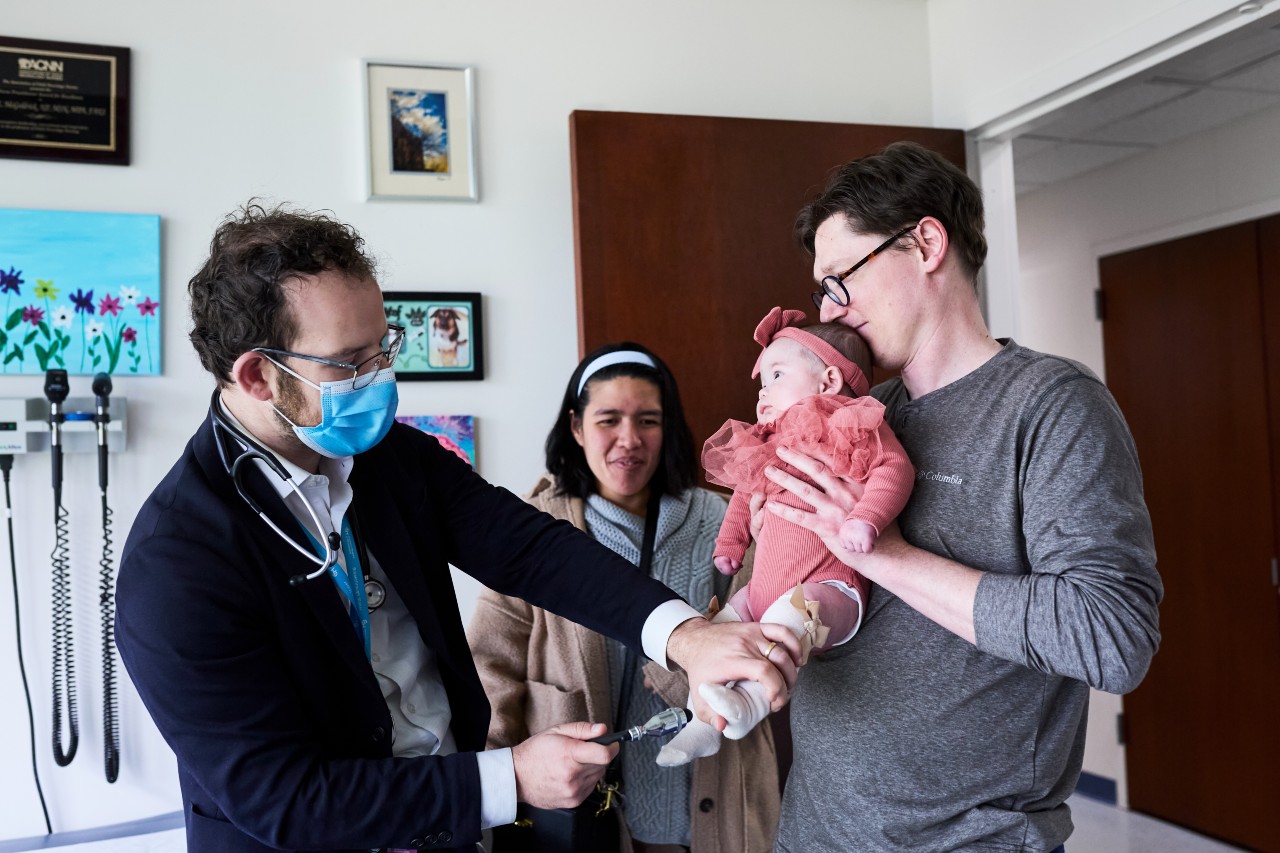
Veronica Barnes never could have imagined that the stroke she had back in 2016 would have a silver lining nine years later. Because of this stroke, when she and her husband Matthew found out they were expecting their daughter, Madison, in 2025, the pregnancy was classified as high risk. The risk distinction led to her primary care and OB-GYN teams advising additional testing.
Genetic testing led to the discovery that both she and her husband were carriers of spinal muscular atrophy, or SMA. SMA is a rare hereditary genetic condition in which muscles throughout the body are weakened because nerve cells in the spinal cord and brainstem do not work properly. SMA is the result of changes to a gene called SMN1. When both parents are carriers, their child has a 25 percent chance of having SMA.
Another round of testing confirmed that Madison was positive for SMN1 mutations on both chromosomes and would be born with SMA. When present at birth or identified in infancy, the prognosis for untreated SMA can be quite poor. But, because of this early prenatal diagnosis, Madison’s care team was able to be extremely proactive. They referred the Barnes family to Dr. Dennis Keselman in the pediatric neuromuscular program at BCHP Neurology. Dr. Keselman and team then got to work setting up the logistics for a treatment plan, to be ready immediately upon delivery.
Every minute counts
Dr. Keselman says that every minute without treatment is significant. He and his team helped Veronica navigate insurance complexities so that both gene therapy with Zolgensma (onasemnogene abeparvovec) and another interim medication, Evrysdi (risdiplam), would be covered. They were able to prepare to have Evrysdi delivered through the manufacturer’s rapid start program, ensuring that Madison would be treated as soon as possible.
There are three treatment options available for SMA. Gene therapy with Zolgensma, where the lacking genetic material, in this case related to SNM1, is administered to the child via infusion, is one. It is preferable for many families because it is a one-time infusion that does not require lifelong medication. For Madison, Dr. Keselman prescribed Evrysdi to start at birth, followed by gene therapy soon after when it could be covered by insurance.
Medicine at birth
Once Veronica reached her delivery day in November 2025, everything was ready. Within minutes of Madison’s birth at Westchester Medical Center, the Evrysdi was sent. “She got the medicine 16 hours after birth. I’ve never heard of anyone getting it that early,” says Dr. Keselman.
Two months later, the gene therapy was available for Madison. Her BCHP care team arranged for her to receive it at the Bradhurst Hematotherapy Center in Hawthorne, part of Westchester Medical Center. The treatment was an extraordinary success, and then she was able to stop Evrysdi. This marked an exciting milestone for BCHP, Westchester Medical Center, and our local region as well, being the first systemic gene therapy performed in the Hudson Valley.
Treating Madison with Zolgensma was an interdisciplinary effort with members of BCHP Hematology, Oncology, and Stem Cell Transplantation, including Dr. Mitchell Cairo, Dr. Edo Schaefer, nurse practitioner Sandra Fabricatore, the WMC Hematotherapy Center, and the WMC Cellular and Tissue Engineering Laboratory (CTEL). Once a patient is infused with a systemic gene therapy such as Zolgensma, they require very close monitoring for up to several months, which requires a team of experts to convene when needed.
The Barnes family credits their faith and views the timing of it all as perfect. “If I was not a high-risk pregnancy, I would not have gone to Westchester and found out about SMA,” Veronica says.
No signs of SMA
According to Dr. Keselman, “this is a story of everything coming together perfectly.” While it was a team effort by many nurses, doctors, scientists, and operations staff, Veronica and Matthew view Dr. Keselman as the glue and lynchpin of making it all happen. “I’m so thankful for Dr. Keselman; he always went the extra mile and was very on top of things. He knew every step and remembered everything,” Veronica says.
Perhaps the best part is that Madison is now thriving and shows no signs of SMA. She is developmentally doing great. Dr. Keselman meets with the family frequently, where he performs a muscle ultrasound and nerve conduction study to make sure everything is going well.
Drs. Keselman, Cairo, and Schaefer have expanded the Gene Therapy program and onboarded more gene therapies. Dr. Keselman views the Barnes’ story as the first in a growing systemic gene therapy program at BCHP.